FSI researchers consider international development from a variety of angles. They analyze ideas such as how public action and good governance are cornerstones of economic prosperity in Mexico and how investments in high school education will improve China’s economy.
They are looking at novel technological interventions to improve rural livelihoods, like the development implications of solar power-generated crop growing in Northern Benin.
FSI academics also assess which political processes yield better access to public services, particularly in developing countries. With a focus on health care, researchers have studied the political incentives to embrace UNICEF’s child survival efforts and how a well-run anti-alcohol policy in Russia affected mortality rates.
FSI’s work on international development also includes training the next generation of leaders through pre- and post-doctoral fellowships as well as the Draper Hills Summer Fellows Program.
Consider the lowly worm. For some, it’s just a garden pest. But for more than a billion people in the developing world, parasitic worms can be a pernicious threat, causing disease, disability and sometimes death.
In a newly published perspective in the medical journal The Lancet, Stanford researchers, including Stanford Health Policy's Eran Bendavid and a host of distinguished colleagues, urge the World Health Organization to develop sweeping new guidelines to help end parasitic worm diseases, one of the world’s most prevalent health problems. They call for greatly expanded treatment of these diseases, which could save years of human suffering and an estimated $3 billion in lost productivity — similar to the impact of the Ebola and Zika epidemics of recent years, they say.
“Now everyone is coming together to say, ‘Now is the time, after more than a decade of new experience and data, to update the way we do things,’ said Nathan Lo, a Stanford MD/PhD candidate who is the first author of the commentary. “There is so much opportunity, whether it’s expanding treatment from children to the entire community or bringing in other strategies, such as sanitation, to strengthen the way we approach these diseases.”
The perspective is published today in Lancet Infectious Diseases and coincides with a WHO meeting in Geneva where officials, including many of the authors, are gathering to consider new treatment guidelines.
As he explained during the recent Rosenkranz Prize Symposium, Stefano M. Bertozzi used this slogan to promote health reform in the Mexico City prison system. By encouraging inmates to step up and get themselves tested for HIV and other chronic illnesses, Bertozzi, dean and professor of health policy and management at the UC Berkeley School of Public Health, was able to decrease the spread of illnesses in Mexican prisons and the surrounding communities.
The Rosenkranz Prize Symposium celebrated research projects that—like Bertozzi’s—address the health care needs of the world’s most vulnerable populations. With support from the Rosenkranz Prize for Health Care Research in Developing Countries, Stanford scholars have stepped up to tackle health issues in regions in need.
Since 2010, the award has funded six young Stanford researchers who aim to improve health in developing countries. The symposium celebrated their achievements.
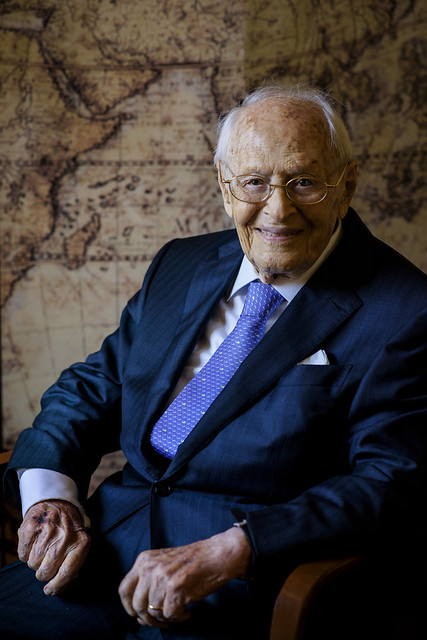
The award honors the work of Dr. George Rosenkranz who spent his career reducing health disparities around the globe. Rosenkranz, who was the first to synthesize cortisone and the active ingredient in the first oral contraceptive, also celebrated his 100th birthday at the symposium.
Producing research that will increase care for vulnerable populations globally is the ultimate goal of the Rosenkranz Prize.
Andrés Moreno-Estrada, the 2012 winner, has used the award to study genetics in Latin American and Caribbean populations, aiming to increase knowledge of potential genetic illnesses. He said, “The Rosenkranz Prize is a clear, important step forward to demonstrate that we can do cutting edge science in developing countries that is of international relevance.”
Other winners include Eran Bendavid, Sanjay Basu, Marcella Alsan, Jason Andrews and Ami Bhatt. Their projects range from the effect of AIDS relief efforts on health care delivery to the treatment of diabetes in India to low-cost diagnostic tools for regions lacking infrastructure.
“I can’t think of a better way to celebrate (my father’s) birthday than listening to the bright future of science,” said Ricardo T. Rosenkranz, son of Dr. George Rosenkranz and a prize donor. “We can’t wait to hear what the next Rosenkranz Prize winners tell us.”
Dr. George Rosenkranz celebrated his 100th birthday at the symposium. The first to synthesize cortisone as well as the active ingredient in the first oral contraceptive, Rosenkranz spent his life reducing health disparities around the globe. | Ryan Zhang
The Asia Health Policy Program at Stanford’s Shorenstein Asia-Pacific Research Center, in collaboration with scholars from Stanford Health Policy's Center on Demography and Economics of Health and Aging, the Stanford Institute for Economic Policy Research, and the Next World Program, is soliciting papers for the third annual workshop on the economics of ageing titled Financing Longevity: The Economics of Pensions, Health Insurance, Long-term Care and Disability Insurance held at Stanford from April 24-25, 2017, and for a related special issue of the Journal of the Economics of Ageing.
The triumph of longevity can pose a challenge to the fiscal integrity of public and private pension systems and other social support programs disproportionately used by older adults. High-income countries offer lessons – frequently cautionary tales – for low- and middle-income countries about how to design social protection programs to be sustainable in the face of population ageing. Technological change and income inequality interact with population ageing to threaten the sustainability and perceived fairness of conventional financing for many social programs. Promoting longer working lives and savings for retirement are obvious policy priorities; but in many cases the fiscal challenges are even more acute for other social programs, such as insurance systems for medical care, long-term care, and disability. Reform of entitlement programs is also often politically difficult, further highlighting how important it is for developing countries putting in place comprehensive social security systems to take account of the macroeconomic implications of population ageing.
The objective of the workshop is to explore the economics of ageing from the perspective of sustainable financing for longer lives. The workshop will bring together researchers to present recent empirical and theoretical research on the economics of ageing with special (yet not exclusive) foci on the following topics:
Public and private roles in savings and retirement security
Living and working in an Age of Longevity: Lessons for Finance
Defined benefit, defined contribution, and innovations in design of pension programs
Intergenerational and equity implications of different financing mechanisms for pensions and social insurance
The impact of population aging on health insurance financing
Economic incentives of long-term care insurance and disability insurance systems
Precautionary savings and social protection system generosity
Elderly cognitive function and financial planning
Evaluation of policies aimed at increasing health and productivity of older adults
Population ageing and financing economic growth
Tax policies’ implications for capital deepening and investment in human capital
The relationship between population age structure and capital market returns
Evidence on policies designed to address disparities – gender, ethnic/racial, inter-regional, urban/rural – in old-age support
The political economy of reforming pension systems as well as health, long-term care and disability insurance programs
Submission for the workshop
Interested authors are invited to submit a 1-page abstract by Sept. 30, 2016, to Karen Eggleston at karene@stanford.edu. The authors of accepted abstracts will be notified by Oct. 15, 2016, and completed draft papers will be expected by April 1, 2017.
Economy-class travel and accommodation costs for one author of each accepted paper will be covered by the organizers.
Invited authors are expected to submit their paper to theJournal of the Economics of Ageing. A selection of these papers will (assuming successful completion of the review process) be published in a special issue.
Submission to the special issue
Authors (also those interested who are not attending the workshop) are invited to submit papers for the special issue in the Journal of the Economics of Ageing by Aug. 1, 2017. Submissions should be made online. Please select article type “SI Financing Longevity.”
About the Next World Program
The Next World Program is a joint initiative of Harvard University’s Program on the Global Demography of Aging, the WDA Forum, Stanford’s Asia Health Policy Program, and Fudan University’s Working Group on Comparative Ageing Societies. These institutions organize an annual workshop and a special issue in the Journal of the Economics of Ageing on an important economic theme related to ageing societies.
“Vic-TOR-ia!” Fátima cried, a grin lighting up her face. The 5-year-old had become fast friends with Stanford medical student Tori Bawel almost instantly after Bawel arrived in San Lucas Tolimán. After giving piggy-back rides to Fátima, a career in global pediatrics changed from a distant wish to a developing reality for Bawel.
Bawel is one of a few lucky medical students to travel with Stanford pediatrician Paul Wise, MD, MPH, to San Lucas Tolimán, a town in the mountains of rural Guatemala that serves as a base for his work to improve nutrition for local children. Once she completes her medical training, Bawel plans to devote her life to improving health in underserved areas.
“As an elementary school student, I was really compelled by issues of social justice,” she said. “I hope that over the course of my lifetime, I’m able to make a difference like physicians have done here in Guatemala and around the world.”
Every summer, Wise, a professor of pediatrics and a Stanford Health Policy core faculty member, takes a handful of undergraduates to the communities around San Lucas to learn about the Rural Guatemala Child Health and Nutrition Program. A collaboration between Stanford and a group of local health promoters, the program uses nutritional supplements and health education to save the lives of children under five. The students follow the promoters on house visits, help them measure the weight and height of children and gain an understanding of how the program helps the rural communities.
“We feel it is part of our educational mission,” said Wise. “We want to grow people who will make a difference, and part of that is providing them opportunities to do so.”
Bawel’s experience reinforced her desire to engage in global health work: “It’s inspired me and motivated me to want to give my life, like Wise, to… serving in areas of the world with the greatest need.”
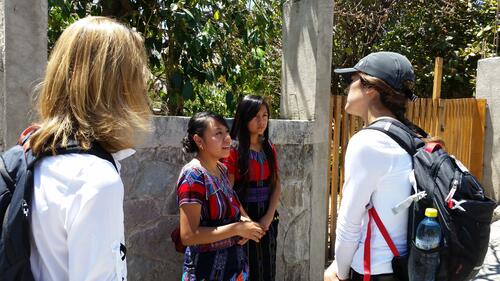
Meeting Guatemalan students who overcame economic difficulties to study medicine — like Flor Julajuj — was also deeply moving for Bawel. Very few in rural Guatemala have the opportunity to pursue higher education or good health care. But with some help from Wise, Julajuj was able to attend medical school; just this month, she graduated from the University of San Carlos in Guatemala City.
Image
“It’s been a great opportunity,” said Julajuj. “It’s changed my life.”
Most, though, are not so lucky; Bawel also encountered two young women who dream of becoming physicians but cannot afford medical school. Meeting the young, ambitious women “makes me want to empower them with the education and opportunities I have had,” said Bawel.
Wise, meanwhile, will continue to each Stanford students about ways to help these communities.
“They see the poverty, but they also begin to understand why being a great doctor or a great diplomat or a great economist will serve the interests of people down here if done well,” he said. “We want them to go back to whatever field they’re interested in, committed to gaining skills and then using them to serve the needs and the rights of people in places like San Lucas.”
When assistant professor of medicine Eran Bendavid began a study on livestock in African households to determine impact on childhood health, he'd already anticipated common field problems like poorly captured or intentionally misreported data, difficulty getting to work sites, or problems with training local volunteers.
But he'd never gotten that particular question from a fieldworker before. It didn't occur to him that participating families, in reporting their livestock holdings, would completely omit the chickens running around at their feet, thereby skewing the data.
"They didn't consider chickens to be livestock," recalled Bendavid. Along with Scott Rozelle, the Helen F. Farnsworth Senior Fellow at FSI, and associate professor of political science and FSI senior fellow Beatriz Magaloni, Bendavid spoke to a full house last week on lessons learned from fieldwork gone awry. The return engagement of FSI's popular seminar, "Everything that can go wrong in a field experiment” was introduced by Jesper Sørensen, executive director of Stanford Seed, and moderated by Katherine Casey, assistant professor of political economy at the GSB. The seminar is a product of FSI and Seed’s joint Global Development and Poverty (GDP) Initiative, which to date has awarded nearly $7 million in faculty research funding to promote research on poverty alleviation and economic development worldwide.
Rozelle, co-director of the Rural Education Action Program, spoke of the obstacles to accurate data gathering, especially in rural areas where record-keeping is inaccurate and participants' trust is low. Arriving in a Chinese village to carry out child nutrition studies, said Rozelle, "we found Grandma running out the back door with the baby." The researchers had worked with the local family planning council to find the names of children to study, but the families thought the authorities were coming to penalize them for violation of the one-child policy.
Cultural differences make for entertaining and illuminating (if frustrating) lessons, but Beatriz Magaloni, director of FSI's Program on Poverty and Governance at the Center on Democracy, Development and the Rule of Law had a different story to tell. Over the course of three years, her GDP-funded work to investigate and reduce police violence in Brazil - a phenomenon resulting in more than 22,000 deaths since 2005 - has encountered obstacle after obstacle. Her work to pilot body-worn cameras on police in Rio has faced a change in police leadership, setting back cooperation; a yearlong struggle to decouple a study of TASER International’s body worn cameras from its electrical weapons in the same population; a work site initially lacking electricity to charge the cameras or Internet to view the feeds; and noncompliance among the officers. "It's discouraging at times," admitted Magaloni, who has finally gotten the cameras onto the officers' uniforms and must now experiment with ways to incentivize their use. "We are learning a lot about how institutional behavior becomes so entrenched and why it's so hard to change."
Experimentation is a powerful tool to understand cause and effect, said Casey, but a tool only works if it's implemented properly. Learning from failure makes for an interesting panel discussion. The speakers' hope is that it also makes for better research in the future.
The Global Development and Poverty Initiative is a University-wide initiative of the Stanford Institute for Innovation in Developing Economies (Seed) in partnership with the Freeman Spogli Institute (FSI). GDP was established in 2013 to stimulate transformative research ideas and new approaches to economic development and poverty alleviation worldwide. GDP supports groundbreaking research at the intersection of traditional academic disciplines and practical application. GDP uses a venture-funding model to pursue compelling interdisciplinary research on the causes and consequences of global poverty. Initial funding allows GDP awardees to conduct high-quality research in developing countries where there is a lack of data and infrastructure.
Infant deaths in Massachusetts for much of the 1800s accounted for more than 20 percent of all deaths, many due to diarrhea, cholera and other gastrointestinal disorders.
But from 1870 to 1930, the infant mortality rate plummeted from around 1 in 5 white infants to 1 in 16 for both Massachusetts and the entire United States.
Studies have shown that the dramatic decline was due to the impact of a clean-water system in Boston and other major U.S. cities at that turn of the 20th century.
Now, new research by Stanford Health Policy’s Marcella Alsan indicates that effective sewage systems installed in Boston and surrounding municipalities complemented the water treatment plants and had a significant role in protecting the lives of children.
“We were motivated to investigate this because there was a watershed moment when infant mortality began to decline in the U.S. and Massachusetts that we wanted to understand,” said Alsan, an assistant professor in the Department of Medicine, and the country’s only physician who is a tropical disease expert and economist.
“In retrospect, the daunting challenges these engineers and medical professionals faced in designing, financing and executing such a massive project is incredible,” Alsan said in an interview. “It was really inspiring to read the history of how it all came together.”
She and co-author, Claudia Goldin of Harvard University’s Department of Economics, analyzed about 200,000 of infant death certificates in Boston and 54 other Massachusetts municipalities spanning the years 1880 to 1915.
The impetus behind the creation of the Metropolitan Sewerage District was complaints regarding the stench of sewage among Boston’s upper-class citizens.
“The first of a series of hearings was given by the sewerage commission at the City Hall on Friday night,” read a story in an 1875 edition of the Boston Medical and Surgical Journal. “From the statements made it would appear in various parts of the district including most of the finest streets, the stench is terrible, often causing much sickness.”
A joint engineering and medical commission was appointed in 1875 to devise a remedy and a massive drainage project got underway.
Alsan and Goldin found that an overwhelming number of deaths in the greater metropolitan area were due to gastrointestinal disorders, but that this improved significantly when sanitation canals became part of the overall water systems.
“We find robust evidence that the pure water and sewerage treatments pioneered by far-sighted public servants and engineers in the Commonwealth saved many babies,” they write in a working paper. “It must also have enhanced the quality of life for the citizens of the Greater Boston area even if it did not reduce the non-child death rate by much.”
Image
They acknowledge that the interpretation of their results is intuitive. But it’s an important one to promote because many developing countries today have yet to heed the lesson of combining safe drinking water and improved sanitation systems.
“Without proper disposal of fecal material, the benefits of clean water technologies for the health of children are likely limited,” they write. “Such a result has relevance for today’s low-and middle- income countries.”
The Millennium Development Goal Target 7.C — to halve by 2015 the proportion of the population without sustainable access to safe drinking water and basic sanitation —was only met for water, but not sanitation. Between 1990 and 2015, 2.6 billion people gained access to improved drinking water sources.
Yet despite that progress, one-third of the global population is still using unimproved sanitation facilities, including nearly 1 billion people who are still forced to defecate in the open. This often leads to cholera, typhoid, hepatitis, polio, and worm infestation.
Diarrhea is the third-largest killer of children under 5 in sub-Saharan Africa, and 44 million pregnant women are infected with worms each year due to open defecation, according to the United Nations. Every minute, 1.1 million liters of human excrement enters the Ganges River in India.
The problem of waste disposal likely will be compounded by rapid urbanization occurring in the developing world, said Alsan, and lack of sanitation and the practice of open defecation costs the world’s poorest countries $260 billion a year.
“We think our findings underscore how complementary these infrastructure investments are, and hope that holds lessons for the developing world,” said Alsan. “In all practicality, it’s very hard to ensure the municipal water supply is not contaminated if the sewage infrastructure is neglected.”
Grant Miller, associate professor of medicine and a Stanford Health Policy core faculty member and senior fellow at the Freeman Spogli Institute, has been working to help residents of a state in India access the micronutrients that they are lacking. The work, which involves a fortified rice, includes several Indian ministries, nonprofit organizations, and faculty from across the Stanford campus to assess and support the collaborative effort.
In this video, Miller says Stanford's collaborative community and institutes help projects like his in the southeastern India state of Tamil Nadu succeed. "Micronutrient deficiency rates in Tamil Nadu are extremely high," he says. "We're working with the government of Tamil Nadu to see if it's possible to introduce fortification into what's called the public distribution system — which distributes rice at no cost to all residents of Tamil Nadu."
And, Miller says, he would not be able to carry out that research without the teamwork generated here on campus.
Stanford students belong to the first generation that could witness the end of extreme global poverty — in what would be one of humankind's greatest achievements — the head of the World Bank said during a recent talk on campus.
But their generation, he said, is also likely to experience the first global pandemic since the 1918 influenza that killed more than 50 million people.
Jim Yong Kim, president of the World Bank, said innovations in health, education and finance are behind the World Bank's twin goals of ending extreme poverty and boosting shared prosperity for the bottom 40 percent of the global population.
Speaking at the inaugural conference of the Stanford Global Development and Poverty Initiative on Oct. 29, Kim lauded faculty and students for their multidisciplinary approach in tackling poverty and improving public health. He is an infectious disease physician who oversaw World Health Organization initiatives on HIV/AIDS.
"Seeking transformative solutions to challenges of development and poverty that are necessarily cross-disciplinary is exactly what a great university should be doing," Kim said in his speech at Stanford.
The World Bank announced last month that the number of people living on less than $1.90 a day is expected to drop to 9.6 percent of the global population by the end of the year. That is down from 36 percent in 1990.
The bank has pledged to cut that rate to 3 percent by 2030.
"We expect the extreme poverty rate to drop below 10 percent for the first time in human history," he said. "This is the best news in the world today. And this is the first generation in human history that has been able to see that potential outcome."
Promoting prosperity
One of the co-founders of Partners in Health, Kim was the keynote speaker at the daylong conference, "Shared Prosperity and Health," which drew together Stanford faculty and researchers, plus government and NGO officials from around the world.
Kim's talk was optimistic about the newly adopted U.N. Sustainable Development Goals, with an ambitious agenda to end poverty and hunger, ensure healthy lives, empower women and girls and attain quality education for all children by 2030.
While those goals seem lofty, Kim pointed to the accomplishment of bringing down extreme poverty to 10 percent, a figure many had once said was impossible.
Ninety-one percent of children in developing countries now attend primary school, up from 83 percent in 2000, he said. And the number of people on antiretroviral drugs for treatment of HIV in sub-Saharan Africa has increased eightfold in the last decade.
"But we're humbled by the challenges ahead," Kim said. "Rising global temperatures will have devastating impacts on poor countries and poor people – and, as we saw with Ebola, major pandemics are likely to disproportionately affect the poor."
Pandemic threats
Kim said that most virologists and infectious disease experts are certain a pandemic will sweep the world in the next 30 years. He said that would lead to more than 30 million deaths and anywhere from 5 to 10 percent of lost GDP.
He blasted the global community for taking eight months to respond to the Ebola crisis in West Africa, noting that Guinea, Sierra Leone and Liberia had among the fastest growing economies in Africa before the outbreak killed more than 11,000 people – most of whom were poor.
In an effort to speed up financial aid the next time such an outbreak occurs, the World Bank is developing the Pandemic Emergency Facility, which would disburse funding immediately to national governments and responding agencies.
Rajiv Shah, the administrator for the U.S. Agency for International Development from 2010-2015, spoke earlier at the conference about his work leading the U.S. efforts to contain Ebola.
"Three small countries with total population of maybe 30 million people had such weak health systems with so little domestic investment – in one country $6 per capita health investment per year – that when Ebola became a crisis there was no first-line of defense," he said.
By October 2014, the U.S. was pouring hundreds of millions of dollars into containment efforts, including the establishment of a 2,500-personnel military deployment to hit Ebola on the ground. Shah said President Obama "stayed extraordinarily true to the science" of containment at the source.
Image
Stunted children
Moving beyond containment of epidemics, Kim said the most important investment developing countries could make in their people starts when a woman becomes pregnant. Using a combination of health, nutrition and education will have lifelong benefits for each child, as well as for the country in which each prospers.
The World Bank estimates that 26 percent of all children under age 5 in developing countries are stunted, which means they are malnourished and under-stimulated, risking a loss of cognitive abilities that lasts a lifetime. The number climbs to 36 percent in sub-Saharan Africa, giving those children limited prospects in life."This is a disgrace, a global scandal and, in my view, akin to a medical emergency," Kim said. "Children who are stunted by age 5 will not have an equal opportunity in life. If your brain won't let you learn and adapt in a fast-changing world, you won't prosper and, neither will society. All of us lose."
From 2001 to 2013, the World Bank invested $3.3 billion in early childhood development programs in poor countries. Kim said innovative policymaking and financial tools allowed the bank to help Peru cut its rate of child stunting in half to 14 percent in just eight years.
"Progress is possible – and it can happen quickly. But we must do even more,"he said.
Kim said the world set a target in 2012 to reduce stunting in children by 40 percent. But that would still leave 100 million children malnourished and undereducated. The bank and world leaders should pledge to end stunting for all children by 2030, he said.
"With partners like the Global Development and Poverty Initiative and the entire Stanford community, I'm full of hope that we can indeed be the first generation in human history to end extreme poverty and create a more just and prosperous world for everyone on the planet."
Efforts to address the global healthcare workforce crisis focus heavily on traditional service providers such as physicians and nurses. Yet, improving health systems also necessitates involvement from a wide range of management and support workers. Global Health Corps (GHC) pairs a team of at least two skilled management and support fellows (one local and one non-local fellow) from sub-Saharan Africa and the United States to work in partnership with non-profit and government agencies focused on the implementation of health services in a setting of poor health outcomes in sub-Saharan Africa or the United States. This manuscripts presents a five-year evaluation of the program. By filling the human resources gaps of global health organizations with management and support workers, GHC and similar approaches may help generate a new pipeline of local and global leaders in global health.
Stanford Assistant Professor of Medicine Marcella Alsan had always wondered why the mineral-rich African continent — with so many natural resources, diverse climates and arable land — remains so poor.
She launched into extensive research while working on her PhD in economics and has now come up with an intriguing theory: A pesky parasite prevented many precolonial Africans from adopting progressive agricultural methods, a phenomenon that still impacts parts of the continent today.
The tsetse fly has plagued Africa for centuries — having sent millions of people into the confusing stupor of sleeping sickness, while killing the cows and other livestock needed to plough their fields and feed their families.
Alsan writes in a paper published in The American Economic Review that the tsetse fly, which today is found only in Africa, drove precolonial Africans to use slaves instead of domesticated animals for agriculture. This limited their crop yields and the ability to transport goods.
“Communicable disease has often been explored as a cause of Africa’s underdevelopment,” writes Alsan, who is the only infectious-disease trained economist in the United States and a core faculty member of the Center for Health Policy/Center for Primary Care and Outcomes Research.
“Although the literature has investigated the role of human pathogens on economic performance, it is largely silent on the impact of veterinary disease,” she notes. “This is peculiar, given the role that livestock played in agriculture and as a form of transport throughout history.”
The economic impact caused by the parasite of the trypanosome vector is estimated to be as much as $4 billion a year. The Food and Agricultural Organization estimates 37 African countries are affected by the tsetse fly and that its trypanosomosis kills around 3 million livestock per year.
The World Health Organization reports that the sleeping sickness delivered by the tsetse bite in humans is hard to diagnose and treat. Some 60 million people were once at risk with an estimated 300,000 new cases each year.
Sleeping sickness causes headaches, fatigue and weight loss; confusion and personality disorders occur as the illness progresses. If left untreated, people typically die after several years of infection.
Fortunately, sustained control efforts have reduced the number of new cases, dropping below 10,000 annual cases annual for the first time in 50 years in 2009. This is in part to an eradication effort using radiation sterilization techniques adopted by the International Atomic Energy Agency.
But the lingering economic impact from the tsetse has been monumental.
For her research, Alsan used geospatial-mapping software to mine data gathered by missionaries and anthropologists in the 1800s. She found that farming methods used in other developing regions of the world — such as the agricultural revolution in England — were not widely adopted in Africa.
“Livestock were really important for development in many places, such as Europe and North America and in some parts of Africa like the highlands of Ethiopia,” Alsan said in an interview. “They pulled plows and carried carts, their manure was used for fertilizer. They helped transport people and goods across land.”
She found that ethnic groups inhabiting tsetse-prone African regions were less likely to use domesticated animals to plow their fields, turning instead to the slash-and-burn technique still used in many parts of the continent today.
The same people were also less likely to be politically centralized, due to lack of transportation by livestock, and had a lower population density.
“These correlations are not found in the tropics outside of Africa, where the fly does not exist,” she writes. “The evidence suggests current economic performance is affected by the tsetse through the channel of precolonial political centralization.”
The FAO estimates that the tsetse fly infects nearly 10 million square kilometers in sub-Saharan Africa. Much of this large area is fertile but left uncultivated, a so-called green desert not used by humans and cattle. Most of the tsetse-infected countries are poor, debt-ridden and underdeveloped.
And this is what triggered Alsan’s interest in the tsetse fly: How its deadly bite has altered the socioeconomic impact of a continent.
“I am an infectious disease doctor, so part of my work is looking at neglected infectious diseases much like this one,” she said. “And it is
incredibly important to shine light on issues that are Africa-specific and therefore may not garner as much attention as those economic and medical issues that affect wealthier regions of the world.”
Alsan, who sees patients at the Stanford University Medical Center and is an investigator at the VA Palo Alto Health Care Systems, is now launching work in India, Ghana and the San Francisco Bay Area. She hopes to better understand how socioeconomic and health disparities interact, and the important role that history plays in understanding those interactions.

 FSI researchers consider international development from a variety of angles. They analyze ideas such as how public action and good governance are cornerstones of economic prosperity in Mexico and how investments in high school education will improve China’s economy.