Hunger
Authors
Beth Duff-Brown
News Type
News
Date
Paragraphs

The U.S. government's global hunger and food security initiative, Feed the Future, has prevented 2.2 million children from experiencing malnutrition in sub-Saharan Africa, according to new research led by Stanford Health Policy's PhD candidate Tess Ryckman.

The researchers compared children’s health in 33 low- and middle-income countries in sub-Saharan Africa. In 12 of those countries, Feed the Future provided services such as agricultural assistance and financial services for farmers, as well as direct nutrition support, such as nutrient supplementation. 

The study, published online Dec. 11 in The BMJ, found a 3.9 percentage point decrease in chronic malnutrition among children served by Feed the Future, leading to 2.2 million fewer children whose development has been harmed by malnourishment.

“What we see with stunting rates is striking,” Ryckman said. “I would argue that 2 million fewer children stunted over seven years is major progress and puts a substantial dent in total stunting levels. And that’s 2 million children who will now have the levels of physical and cognitive development to allow them to reach their full potential.”

Stunting, or having a low height for a particular age, is a key indicator of child malnutrition. Children who aren’t properly nourished in their first 1,000 days are more likely to get sick more often, to perform poorly in school, grow up to be economically disadvantaged and suffer from chronic diseases, according to the World Health Organization.

A Controlled Study

Feed the Future is thought to be the world’s largest agricultural and nutrition program, with around $6 billion in funding from USAID (plus more from other federal agencies) between 2010 and 2015. Despite its size, much remains unknown about the effectiveness of the program.

The researchers analyzed survey data on almost 900,000 children younger than 5 in sub-Saharan Africa from 2000 to 2017. They compared children from the Feed the Future countries with those in countries that are not participants in the program, both before and after the program’s implementation in 2011.

The researchers found the results were even more pronounced — a 4.6 percentage point decline in stunting — when they restricted their sample to populations most likely to have been reached by program. These included children who were younger when the program began, rural areas where Feed the Future operated more intensively, and in countries where the program had greater geographic coverage.

“Our findings are certainly encouraging because it has been difficult for other programs and interventions to demonstrate impact on stunting, and this program has received a lot of funding, so it’s good to see that it’s having an impact,” Ryckman said.

Multifaceted Approach to Nutrition

Experts are divided about the best way to help the world’s 149 million malnourished children: Is assistance that directly targets nutrition, such as breastfeeding promotion or nutrient supplementation, more effective? Or is it also beneficial to tackle the problem at its root by supporting agriculture and confronting household poverty?

The authors, including Stanford Health Policy’s Eran Bendavid, MD, associate professor of medicine, and Jay Bhattacharya, MD, PhD, professor of medicine, a senior fellow (by courtesy) at the Freeman Spogli Institute of International Studies and a senior fellow senior fellow at the Stanford Institute for Economic Policy Research, said their analysis supports the value of a multifaceted approach to combating malnutrition among children, namely leveraging agriculture and food security interventions.

“Independent evaluations of large health policy programs such as Feed the Future help build the evidence base needed to tackle persistent patterns of undernutrition,” said Bendavid, an epidemiologist. “The widespread prevalence of stunting and chronic undernutrition is among the most common and yet most stubborn cause of underdevelopment in the world, and learning what works in this space is sorely needed.”

The researchers, including Stanford medical students Margot Robinson and Courtney Pederson, speculated that possible drivers of the program’s effectiveness include three features of Feed the Future’s design: its country-tailored approach; its focus on underlying drivers of nutrition, such as empowering female farmers; and its large scale and adequate funding.

The authors hope their independent evaluation of the program might lead to more funding and support for it. At the very least, they said, it should demonstrate to people working on Feed the Future and the broader global nutrition program community that programs focused mostly on agriculture and food security — indirect contributors to malnutrition — can lead to success.

Value Unknown

Feed the Future has been scaled back in recent years — it once served 19 countries and now reaches only 12. The program’s budget also remains somewhat murky.

“While there isn’t much data on the program’s funding under the Trump administration, the program appears to have been scaled back, at least in terms of the countries where it operates,” Ryckman said. “It’s possible that some of these gains could be lost, absent longer-term intervention from Feed the Future.”

Image
eran

The researchers also did not look at whether the program provided high value for the money spent.

“While we find that it has been effective, it hasn’t led to drastic declines in stunting and it is unclear whether it is good value for money,” she said.

Ryckman also noted that USAID’s own evaluation of its program is tenuous because it looked only at before-and-after stunting levels in Feed the Future countries without comparing the results to a control group or adjusting for other sources of bias, which is problematic because stunting is slowly declining in most countries.

“These types of evaluations are misleading,” Ryckman said. “The U.S. government really needs to prioritize having their programs independently evaluated using more robust methods. That was part of our motivation for doing this study.”

Support for the study was provided by the National Institutes of Health (grant P20-AG17253), the National Science Foundation and the Doris Duke Charitable Foundation.


Hero Image
gettyimages stunting
An infant child in Somalia is determined to be malnourished using a MUAC tape which is a quick and simple way to determine whether or not a child is malnourished using a simple colored plastic strip.
Getty Images
All News button
1
Authors
News Type
News
Date
Paragraphs

In a shack that now sits below sea level, a mother in Bangladesh struggles to grow vegetables in soil inundated by salt water. In Malawi, a toddler joins thousands of other children perishing from drought-induced malnutrition. And in China, more than one million people died from air pollution in 2012 alone.

Around the world, climate change is already having an effect on human health.

In a recent paper, Katherine Burke and Michele Barry from the Stanford Center for Innovation in Global Health, along with former Wellesley College President Diana Walsh, described climate change as “the ultimate global health crisis.” They offered recommendations to the new United States president to address the urgently arising health risks associated with climate change.

gettyimages 451722570 Bangladeshi children make their way through flood waters.

The authors, along with Stanford researchers Marshall Burke, Eran Bendavid and Amy Pickering who also study climate change, are concerned by how little has been done to mitigate its effects on health.

“I think it’s likely that health impacts could be the most important impact of climate change,” said Marshall Burke, an assistant professor of earth system science and a fellow at the Freeman-Spogli Institute for International Studies.

There is still time to ease — though not eliminate — the worst effects on health, but as the average global temperature continues to creep upward, time appears to be running short.

“I think we are at a critical point right now in terms of mitigating the effects of climate change on health,” said Amy Pickering, a research engineer at the Woods Institute for the Environment. “And I don’t think that’s a priority of the new administration at all.”

Health effects of climate change

Even in countries like the United States that are well-equipped to adapt to climate change, health impacts will be significant.

“Extremes of temperature have a very observable direct effect,” said Eran Bendavid, an assistant professor of medicine and Stanford Health Policy core faculty member.

“We see mortality rates increase when temperatures are very low, and especially when they are very high.”

Bendavid also has seen air pollutants cause respiratory problems in people from Beijing to Los Angeles to villages in Sub-Saharan Africa.

“Hotter temperatures make it such that particulate matter and dust and pollutants stick around longer,” he said.

In addition to respiratory issues, air pollution can have long-term cognitive effects. A study in Chile found that children who are exposed to high amounts of air pollution in utero score lower on math tests by the fourth grade.

“I think we’re only starting to understand the true costs of dirty air,” said Marshall Burke. “Even short-term exposure to low levels can have life-long effects.”

Low-income countries like Bangladesh already suffer widespread, direct health effects from rising sea levels. Salt water flooding has crept through homes and crops, threatening food sources and drinking water for millions of people.

“I think that flooding is one of the most pressing issues in low-income and densely populated countries,” said Pickering. “There’s no infrastructure there to handle it.”

Standing water left over from flooding is also a breeding ground for diseases like cholera, diarrhea and mosquito-borne illnesses, all of which are likely to become more prevalent as the planet warms.

On the flip side, many regions of Sub-Saharan Africa — where clean water is already hard to access — are likely to experience severe droughts. The United Nations warned last year that more than 36 million people across southern and eastern Africa face hunger due to drought and record-high temperatures.

Residents may have to walk farther to find water, and local sources could become contaminated more easily. Pickering fears that losing access to nearby, clean water will make maintaining proper hygiene and growing nutritious foods a challenge.

Flow Chart detailing how Climate CHnage Affects Your Health Climate change will affect health in all sectors of society.

All of these effects and more can also damage mental health, said Katherine Burke and her colleagues in their paper. The aftermath of extreme weather events and the hardships of living in long-term drought or flood can cause anxiety, depression, grief and trauma.

Climate change will affect health in every sector of society, but as Katherine Burke and her colleagues said, “….climate disruption is inflicting the greatest suffering on those least responsible for causing it, least equipped to adapt, least able to resist the powerful forces of the status quo.

“If we fail to act now,” they said, “the survival of our species may hang in the balance.”

What can the new administration do to ease health effects?

If the Paris Agreement’s emissions standards are met, scientists predict that the world’s temperature will increase about 2.7 degrees Celsius – still significant but less hazardous than the 4-degree increase projected from current emissions.

The United States plays a critical role in the Paris Agreement. Apart from the significance of cutting its own emissions, failing to live up to its end of the bargain — as the Trump administration has suggested — could have a significant impact on the morale of the other countries involved.

“The reason that Paris is going to work is because we’re in this together,” said Marshall Burke. “If you don’t meet your target, you’re going to be publicly shamed.”

The Trump administration has also discussed repealing the Clean Power Plan, Obama-era legislation to decrease the use of coal, which has been shown to contribute to respiratory disease.

“Withdrawing from either of those will likely have negative short- and long-run health impacts, both in the U.S. and abroad,” said Marshall Burke.

Scott Pruitt, who was confirmed today as the head of the Environmental Protection Agency (EPA), is expected to carry out Trump’s promise to dismantle environment regulations.

Despite the Trump administration’s apparent doubts about climate change, a few prominent Republicans do support addressing its effects.

Secretary of State Rex Tillerson, the former chairman and CEO of Exxon Mobile, supports a carbon tax, which would create a financial incentive to turn to renewable energy sources. He also has expressed support for the Paris Agreement. It is possible that as secretary of state, Tillerson could help maintain U.S. obligations from the Paris Agreement, though it is far from certain whether he would choose to do so or how Trump would react.

More promising is a recent proposal from the Climate Leadership Council. Authored by eight leading Republicans — including two former secretaries of state, two former secretaries of the treasury and Rob Walton, Walmart’s former chairman of the board — the plan seeks to reduce emissions considerably through a carbon dividends plan.

gettyimages 613945168 Already an issue, malnutrition will increase with droughts in Sub-Saharan Africa.

Their proposal would gradually increase taxes on carbon emissions but would return the proceeds directly to the American people. Americans would receive a regular check with their portion of the proceeds, similar to receiving a social security check. According to the authors, 70 percent of Americans would come out ahead financially, keeping the tax from being a burden on low- and middle-income Americans while still incentivizing lower emissions.

“A tax on carbon is exactly what we need to provide the right incentives and induce the sort of technological and infrastructure change needed to reduce long-term emissions,” said Marshall Burke.

Pickering added, “This policy is a ray of hope for meaningful action on climate.”

It remains to be seen whether the new administration and congress would consider such a program.

What can academics do to help?

Meanwhile, academics can promote health by researching the effects of climate change and finding ways to adapt to them.

“I think it’s fascinating that there’s just so little data right now on how climate change is going to impact health,” said Pickering.

Studying the effects of warming on the world challenges traditional methods of research.

“You can’t create any sort of experiment,” said Bendavid. “There’s only one climate and one planet.”

The scholars agree that interdisciplinary study is a critical part of adapting to climate change and that more research is needed.

“If ever there was an issue worthy of a leader’s best effort, this is the moment, this is the issue,” said Katherine Burke and her colleagues. “Time is short, but it may not be too late to make all the difference.”

Hero Image
smokestacksfinal Lukas Schulze / Getty Images
All News button
1
Authors
News Type
News
Date
Paragraphs

Stanford pediatrician Paul Wise stooped below the black tarp roof of a cinderblock house in Guatemala to offer his condolences to a mother who had just lost her child.

“Doctor Pablo,” as he is known in the communities around San Lucas Tolimán, talked softly as he relayed his sympathies to the mother, whose 9-year-old son had been a patient of his.

Stanford’s Children in Crisis Initiative seeks to save the lives of children in areas of poor governance. In Guatemala, their efforts work toward eliminating death by malnutrition for children under 5.

The boy’s genetic disorder would have been terminal anywhere, but thanks to Wise and local health promoters, the boy’s family had years with him instead of months.

They found the doctor through the Guatemala Rural Child Health and Nutrition Program, a collaboration between Wise and the health promoters to eliminate death by malnutrition for children under 5.

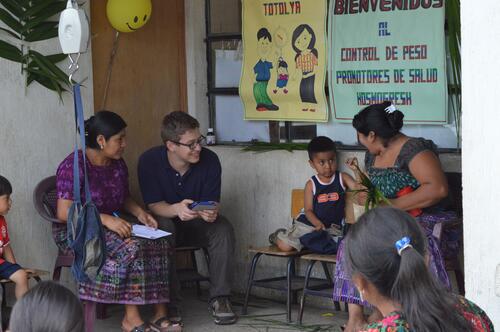
While Wise spoke to the heartbroken mother, his Stanford research assistant Alejandro Chavez helped the promoters set up inside a local community center to measure the weight and height of local kids to determine their nutrition level.

Chavez and the promoters had worked together for months to create an app for tablets that will make it easier to find malnourished children.

The app they designed will decrease training time for new health promoters and allow the program to expand. The goal is to distribute the app globally to help programs in other countries tackle malnutrition.

Children in crisis

As recently as 2005, about one of every 20 children in this rural area of Guatemala died before their 5th birthday. Almost half the deaths were associated with severe malnutrition.

“The death of any child is always a tragedy, but the death of any child from preventable causes is always unjust,” said Wise, a Stanford Health Policy core faculty member.

Along with other faculty from the Freeman Spogli Institute for International Studies (FSI) and the School of Medicine, Wise created the Children in Crisis Initiative to save the lives of children in areas of poor governance. The program brings together Stanford researchers and students across disciplines.

Nowhere are their efforts better illustrated than in the rural communities around San Lucas Tolimán, in the central mountains of Guatemala.

The program’s effectiveness rests on a deep respect for the local communities merged with innovation by Stanford researchers.

“It’s absolutely essential to any program that the people in need be part of the solution,” said Wise. Unlike many nongovernmental organizations and health programs, Wise believes the way to create a sustainable health system is for the locals to run it, so the health promoters manage the program’s day-to-day activities.

Image
26904174966 b790e2fc26 o

This leaves the Stanford team free to focus on innovation – such as the new app. They believe the technology could change child health programs around the world. Wise’s team has partnered with Medic Mobile – a nonprofit that creates open-source software for health care workers – which plans to distribute the app to other areas suffering from malnutrition.

The six Android tablets purchased by Children in Crisis are enough to monitor the program’s 1,500 kids through the app.

Role of nutrition

When done well, nutrition surveillance is very effective at decreasing child mortality in poor countries.

“Nutrition contributes enormously to health and well-being,” Wise said as he walked through Tierra Santa, a small community near San Lucas, making house calls. “So the focus of our work turned to improving young child nutrition. It’s not an easy thing to do in a place that’s extremely poor.”

Wise and his colleagues – Stanford medical student Tori Bawel and Stanford professor of pediatrics Lisa Chamberlain – made their rounds during their visit in March. Evidence of poverty was everywhere.

Here, clean tap water is a dream and even the sturdier homes often lack four walls or paned windows, though the children were neatly dressed in T-shirts or colorful traje, traditional Mayan clothing.

It’s hard to provide proper nutrition when most families can’t find enough work to buy adequate food. But a little help can make a big difference.

Bawel, a first-year medical student who plans a career improving health in areas of poverty, was struck by the impact the promoter program has had on the community.

“There are children who need supplements and nutrition to stay alive,” she said. “Without this program, that infrastructure does not exist.”

With FSI’s assistance, the nutrition program distributes Incaparina, a supplement of cornmeal, soy and essential nutrients. The sweet, mealy drink helps the program’s most malnourished children get back on track.

Image
dsc 0049

Every two months, the promoters gather each community’s children to measure their weight and height. Children and their mothers sit patiently, waiting for their turn. The children enjoy a cup of Incaparina, and their mothers eagerly listen to the promoters’ tips for keeping their children healthy.

“It’s very important to me,” said Elsira Rosibel Samayoa, who brought her 2-year-old to be measured. “There are mothers who don’t understand the importance of monitoring their children’s weight, but I do.”

Since its implementation in 2009, the Stanford program has slashed nutrition-based mortality in the participating communities by about 80 percent and decreased severe malnutrition by more than 60 percent – saving hundreds of children’s lives.

However, nutrition surveillance and intervention isn’t easy. Tracking nutrition takes training and expertise, and when the local population rarely exceeds a fourth-grade education, learning these skills is especially challenging. Detailed graphs on a standard growth chart are essential to identifying malnourished children.

“The community health workers are extremely capable and smart, but some have never seen a graph before,” said Wise. “Think about what it is to try to explain a graph to someone for the first time.”

It takes the health workers about three years to learn to graph and then interpret the results for intervention.

Wise said, “So we all got together and said, ‘How do we make this easier to do?’”

The app was the answer.

‘Let’s create an app’

Enter Alejandro Chavez, a recent Stanford computer science graduate and Stanford Health Policy research assistant. He developed the app to collect child health data, then determine the child’s degree of malnutrition and suggest intervention.

“The major goal was to lower training requirements and make programs like this simpler to start and maintain,” said Chavez, who now lives and works in Guatemala, where he gets daily feedback from the health promoters.

“I feel like they’ve been very honest with me about things I need to improve,” he said.

Cesia Lizeth Castro Chutá is a senior coordinator for the program who has worked with Chavez to ensure that the app meets the promoters’ needs.

“The tablet automatically generates the information we need to know,” she said. “It becomes easier to confirm that a child is malnourished and needs supplements.”

Looking forward
Image
dsc 0324

With the app’s launch, it looks like training time for the promoters will be reduced from three years to less than six months. That means new communities can be incorporated into the program quickly, creating broader access to care.

Meanwhile, many health programs around the world are waiting to see how well the Stanford app works in Guatemala.

Josh Nesbit, a Stanford alumnus and Medic Mobile CEO, said, “As more health programs recognize the importance of nutrition and implement community-based interventions, screening and surveillance tools will be critical. We must learn from Dr. Wise’s success.”


Hero Image
dsc 0266 1 Nicole Feldman
All News button
1
Authors
Beth Duff-Brown
News Type
News
Date
Paragraphs

Stanford students belong to the first generation that could witness the end of extreme global poverty — in what would be one of humankind's greatest achievements — the head of the World Bank said during a recent talk on campus.

But their generation, he said, is also likely to experience the first global pandemic since the 1918 influenza that killed more than 50 million people.

Jim Yong Kim, president of the World Bank, said innovations in health, education and finance are behind the World Bank's twin goals of ending extreme poverty and boosting shared prosperity for the bottom 40 percent of the global population.

Speaking at the inaugural conference of the Stanford Global Development and Poverty Initiative on Oct. 29, Kim lauded faculty and students for their multidisciplinary approach in tackling poverty and improving public health. He is an infectious disease physician who oversaw World Health Organization initiatives on HIV/AIDS.

"Seeking transformative solutions to challenges of development and poverty that are necessarily cross-disciplinary is exactly what a great university should be doing," Kim said in his speech at Stanford.

The World Bank announced last month that the number of people living on less than $1.90 a day is expected to drop to 9.6 percent of the global population by the end of the year. That is down from 36 percent in 1990.

The bank has pledged to cut that rate to 3 percent by 2030.

"We expect the extreme poverty rate to drop below 10 percent for the first time in human history," he said. "This is the best news in the world today. And this is the first generation in human history that has been able to see that potential outcome." 

Promoting prosperity

One of the co-founders of Partners in Health, Kim was the keynote speaker at the daylong conference, "Shared Prosperity and Health," which drew together Stanford faculty and researchers, plus government and NGO officials from around the world.

Stanford's global development and poverty effort is a university-wide initiative of the Stanford Institute for Innovation in Developing Economies, known as Stanford Seed, and the Freeman Spogli Institute for International Studies. The conference was held at Stanford's Graduate School of Business, which was a partner in the event.

Kim's talk was optimistic about the newly adopted U.N. Sustainable Development Goals, with an ambitious agenda to end poverty and hunger, ensure healthy lives, empower women and girls and attain quality education for all children by 2030.


While those goals seem lofty, Kim pointed to the accomplishment of bringing down extreme poverty to 10 percent, a figure many had once said was impossible.

Ninety-one percent of children in developing countries now attend primary school, up from 83 percent in 2000, he said. And the number of people on antiretroviral drugs for treatment of HIV in sub-Saharan Africa has increased eightfold in the last decade.

"But we're humbled by the challenges ahead," Kim said. "Rising global temperatures will have devastating impacts on poor countries and poor people – and, as we saw with Ebola, major pandemics are likely to disproportionately affect the poor."

Pandemic threats

Kim said that most virologists and infectious disease experts are certain a pandemic will sweep the world in the next 30 years. He said that would lead to more than 30 million deaths and anywhere from 5 to 10 percent of lost GDP.

He blasted the global community for taking eight months to respond to the Ebola crisis in West Africa, noting that Guinea, Sierra Leone and Liberia had among the fastest growing economies in Africa before the outbreak killed more than 11,000 people – most of whom were poor.

In an effort to speed up financial aid the next time such an outbreak occurs, the World Bank is developing the Pandemic Emergency Facility, which would disburse funding immediately to national governments and responding agencies.

Rajiv Shah, the administrator for the U.S. Agency for International Development from 2010-2015, spoke earlier at the conference about his work leading the U.S. efforts to contain Ebola.

"Three small countries with total population of maybe 30 million people had such weak health systems with so little domestic investment – in one country $6 per capita health investment per year – that when Ebola became a crisis there was no first-line of defense," he said.

By October 2014, the U.S. was pouring hundreds of millions of dollars into containment efforts, including the establishment of a 2,500-personnel military deployment to hit Ebola on the ground. Shah said President Obama "stayed extraordinarily true to the science" of containment at the source.

Image
world bank poverty

Stunted children 

Moving beyond containment of epidemics, Kim said the most important investment developing countries could make in their people starts when a woman becomes pregnant. Using a combination of health, nutrition and education will have lifelong benefits for each child, as well as for the country in which each prospers.

The World Bank estimates that 26 percent of all children under age 5 in developing countries are stunted, which means they are malnourished and under-stimulated, risking a loss of cognitive abilities that lasts a lifetime. The number climbs to 36 percent in sub-Saharan Africa, giving those children limited prospects in life."This is a disgrace, a global scandal and, in my view, akin to a medical emergency," Kim said. "Children who are stunted by age 5 will not have an equal opportunity in life. If your brain won't let you learn and adapt in a fast-changing world, you won't prosper and, neither will society. All of us lose."

From 2001 to 2013, the World Bank invested $3.3 billion in early childhood development programs in poor countries. Kim said innovative policymaking and financial tools allowed the bank to help Peru cut its rate of child stunting in half to 14 percent in just eight years.

"Progress is possible – and it can happen quickly. But we must do even more,"he said.

Kim said the world set a target in 2012 to reduce stunting in children by 40 percent. But that would still leave 100 million children malnourished and undereducated. The bank and world leaders should pledge to end stunting for all children by 2030, he said.

"With partners like the Global Development and Poverty Initiative and the entire Stanford community, I'm full of hope that we can indeed be the first generation in human history to end extreme poverty and create a more just and prosperous world for everyone on the planet."

Read more here about another innovation to improve health in the developing world.

Hero Image
kim cicero
All News button
1
Authors
News Type
News
Date
Paragraphs

Philanthropist and software giant Bill Gates spoke to a Stanford audience last week about the importance of foreign aid and product innovation in the fight against chronic hunger, poverty and disease in the developing world.

His message goes hand-in-hand with the ongoing work of researchers at Stanford’s Freeman Spogli Institute for International Studies. Much of that work is supported by FSI’s Global Underdevelopment Action Fund, which provides seed grants to help faculty members design research experiments and conduct fieldwork in some of the world’s poorest places.

Four FSI senior fellows – Larry Diamond, Jeremy Weinstein, Paul Wise and Walter Falcon – respond to some of the points made by Gates and share insight into their own research and ideas about how to advance and secure the most fragile nations.

Without first improving people’s health, Gates says it’s harder to build good governance and reliable infrastructure in a developing country. Is that the best way to prioritize when thinking about foreign aid?

Larry Diamond: I have immense admiration for what Bill Gates is doing to reduce childhood and maternal fatality and improve the quality of life in poor countries.  He is literally saving millions of lives.  But in two respects (at least), it's misguided to think that public health should come "before" improvements in governance.  

First, there is no reason why we need to choose, or why the two types of interventions should be in conflict.  People need vaccines against endemic and preventable diseases – and they need institutional reforms to strengthen societal resistance to corruption, a sociopolitical disease that drains society of the energy and resources to fight poverty, ignorance, and disease.  

Second, good governance is a vital facilitator of improved public health.  When corruption is controlled, public resources are used efficiently and justly to build modern sanitation and transportation systems, and to train and operate modern health care systems.  With good, accountable governance, public health and life expectancy improve much more dramatically.  When corruption is endemic, life-saving vaccines, drugs, and treatments too often fall beyond the reach of poor people who cannot make under-the-table payments. 

Foreign aid has come under criticism for not being effective, and most countries have very small foreign aid budgets. How do you make the case that foreign aid is a worthy investment?

Jeremy M. Weinstein: While foreign aid may be a small part of most countries’ national budgets, global development assistance has increased markedly in the past 50 years. Between 2000 and 2010, global aid increased from $78 billion to nearly $130 billion – and the U.S. continues to be the world’s leading donor.

The challenge in the next decade will be to sustain high aid volumes given the economic challenges that now confront developed countries. I am confident that we can and will sustain these volumes for three reasons.

First, a strong core of leading voices in both parties recognizes that promoting development serves our national interest. In this interconnected world, our security and prosperity depend in important ways on the security and prosperity of those who live beyond our borders.

Second, providing assistance is a reflection of our values – it is these humanitarian motives that drove the unprecedented U.S. commitment to fighting HIV/AIDS during the Bush Administration.

Perhaps most importantly, especially in tight budget times, development agencies are learning a great deal about what works in foreign assistance, and are putting taxpayers’ dollars to better use to reduce poverty, fight disease, increase productivity, and strengthen governance – with increasing evidence to show for it.

Some of the most dire situations in the developing world are found in conflict zones. How can philanthropists and nongovernmental organizations best work in places with unstable governments and public health crises? Is there a role for larger groups like the Gates Foundation to play in war-torn areas?

Paul H. Wise: As a pediatrician, the central challenge is this: The majority of preventable child deaths in Sub-Saharan Africa and in much of the world occur in areas of political instability and poor governance. 

This means that if we are to make real progress in improving child health we must be able to enhance the provision of critical, highly efficacious health interventions in areas that are characterized by complex political environments – often where corruption, civil conflict, and poor public management are the rule. 

Currently, most of the major global health funders tend to avoid working in such areas, as they would rather invest their efforts and resources in supportive, well-functioning locations.  This is understandable. However, given where the preventable deaths are occurring, it is not acceptable. 

Our efforts are directed at creating new strategies capable of bringing essential services to unstable regions of the world.  This will require new collaborations between health professionals, global security experts, political scientists, and management specialists in order to craft integrated child health strategies that respect both the technical requirements of critical health services and the political and management innovations that will ensure that these life-saving interventions reach all children in need.

Gates says innovation is essential to improving agricultural production for small farmers in the poorest places. What is the most-needed invention or idea that needs to be put into place to fight global hunger?

Walter P. Falcon: No single innovation will end hunger, but widespread use of cell phone technology could help.

Most poor agricultural communities receive few benefits from agricultural extension services, many of which were decimated during earlier periods of structural reform. But small farmers often have cell phones or live in villages where phones are present.

My priority innovation is for a  $10 smart phone, to be complemented with a series of very specific applications designed for transferring knowledge about new agricultural technologies to particular regions.  Using the wiki-like potential of these applications, it would also be possible for farmers from different villages to teach each other, share critical local knowledge, and also interact with crop and livestock specialists.

Language and visual qualities of the applications would be key, and literacy problems would be constraining.  But the potential payoff seems enormous.

Hero Image
RTXG95C logo
Children play near a punctured water pipe in Nairobi's Kibera slums.
REUTERS/Noor Khamis
All News button
1
Subscribe to Hunger