
Global Health's Moment of Reckoning—and Reinvention
Global Health's Moment of Reckoning—and Reinvention
The 2026 Rosenkranz Global Health Policy Symposium explores the current landscape and future directions for global health.

A renowned panel of global health experts said their community has undergone a seismic shift in the last year with the dismantling of USAID, the U.S. withdrawal from the World Health Organization and sweeping cuts to foreign aid, research and development.
Yet they believe this momentous inflection point offers public health officials an opportunity to build better institutions, and they gave the next generation of global health leaders a constructive path forward.
“There’s been a bit of an earthquake over the last year, so now with the pieces that fall in front of us, the question is how they get restructured,” said Secretary Condoleezza Rice, PhD, the Tad and Dianne Taube Director of the Hoover Institution and the 66th U.S. secretary of state. “We are in uncharted territory about what comes next. We are leaving an 80-year-old system of security, of economics and trade, of global health, and the role the United States played. All of that is effectively now on the table—because people think that we should not go back there.”
Rice was addressing the fifth annual Rosenkranz Global Health Policy Symposium sponsored by the Stanford Health Policy and the Freeman Spogli Institute for International Studies. The keynote conversation was between Rice and Jennifer Kates, senior vice president and director of the Global and Public Health Policy Program at KFF.
The May 28 symposium was devoted to examining global health at this crossroads.
On his first day back in office, President Trump ordered a 90-day review of foreign aid, followed immediately by a stop-work order freezing all payments and services already underway. Two days later, the Department of Health and Human Services announced a full withdrawal from the WHO, citing its mishandling of COVID-19 and failure to operate independently of member-state influence. The administration then notified Congress that the U.S. Agency for International Development would be dissolved; a subsequent study in The Lancet projected the dismantling could result in 14 million additional deaths by 2030.
Rice and Kates told the symposium that USAID would likely never be re-established under its old model, often derided as bloated and too removed from those they set out to serve. They also said the WHO—criticized for bureaucratic inefficiencies, delayed emergency responses and lack of transparency—needs to be completely overhauled.
“This is not an indictment of the people in the health policy establishment or people who are delivering, but the World Health Organization needs to be rebuilt,” Rice said. “And I almost feel that at this point to get the kind of support that you're going to need from the United States, it’s going to have to be built from the ground up—because you can't do it without some kind of international coordinating mechanism.”
Looking Back
Eran Bendavid, MD, professor of health policy and of medicine, moderated the keynote conversation. He started by asking Rice and Kates about the President’s Emergency Plan for AIDS Relief (PEPFAR), widely considered the most ambitious and transformative U.S. foreign aid program since the Marshall Plan helped rebuild Europe after World War II. Since its inception in 2003 under President George W. Bush, the program is credited with saving some 26 million lives and preventing millions of new infections.
Both Rice and Kates were instrumental in its success; Rice as one of its primary architects and Kates as a leading independent analyst of the agency’s funding and results.
Rice advised Bush that his agenda in Africa would fail without addressing the AIDS pandemic, warning him that up to 100 million people could die on the continent if the crisis was not addressed. They worked with the faith-based community, AIDS advocates, U2 frontman Bono, the Congressional Black Caucus and others on Capitol Hill from both sides of the aisle—imploring them to keep the initiative a secret until he could unveil it in a way that would make it hard for Congress to turn down his whopping funding request.
Rice said Bono had worked closely with the Bush administration on the Millennium Challenge, a major bilateral foreign aid initiative announced in March 2002. But the musician really wanted the administration to focus on HIV/AIDS.
“I said, ‘Bono, you're going to have to trust us, we're going to do something about AIDS,’” Rice said. “Imagine getting an Irish rocker and a Texan together. I first had to tell President Bush that U2 actually was a band and not a reconnaissance plane. They met and I think Bono became a big part of our being able to do this.” Kates recalled watching Bush deliver his 2003 State of the Union Address—and the moment he announced that he would request $15 billion to fight HIV-AIDS in Africa, she knew something had shifted.
“The fact that the U.S. government under a Republican president was coming out and announcing this new initiative without it being known before was a dramatic, once-in-a-lifetime moment,” Kates said.
The program remained so successful, they said, due to strong oversight and a deep engagement on the part of African leaders, public health officials and local community programs across the continent.
Looking Forward
Despite its success, PEPFAR is in limbo, with its latest authorization having expired in March 2025. The administration’s 2026 fiscal budget request includes $2.9 billion for bilateral PEPFAR activities, a decrease of $1.9 billion from prior levels.
Rice assumes PEPFAR won't be dismantled like USAID, but there likely will be changes to its funding.
“I just can’t emphasize enough how much the United States sometimes has to be a catalyst, the United States has to mobilize others, but at some point, those on the ground also have to be able to take up the mantle,” Rice said. “I’m hoping that it lasts another 23 years … but there probably will be some shifting of responsibility and some shifting of funding—maybe that’s just going to have to be the case.”
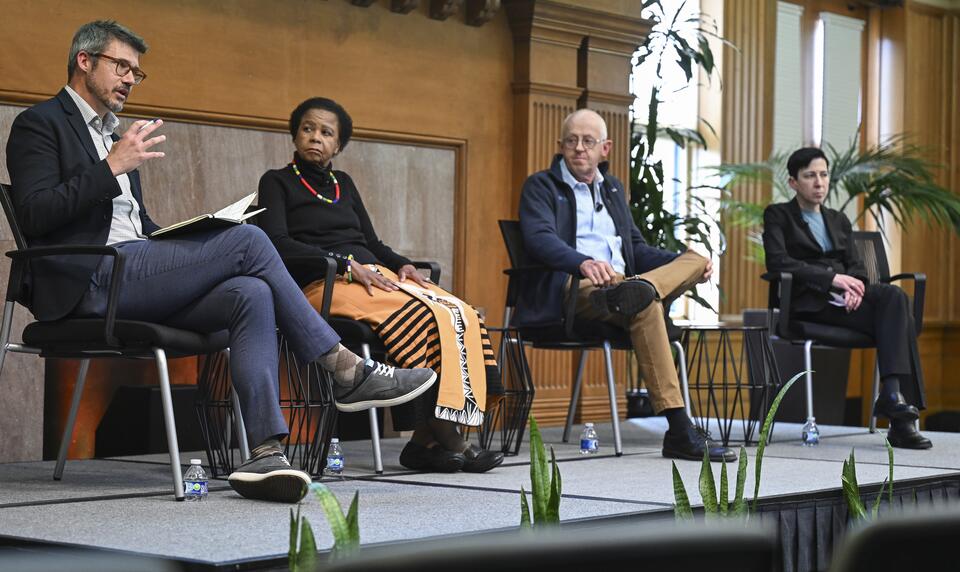
Michele Barry, MD, senior associate dean for global health and director of the Stanford Center for Innovation in Global Health, moderated a wider panel after the keynote conversation. She turned to the administration’s America First Global Health Strategy, asking Kates to give an overview of the new roadmap for global health.
Kates said the leading approach to foreign aid by the administration appears to be developing bilateral agreements with individual countries. There are now 32 signed Memorandums of Understanding (MOUs), with total funding of $20.3 billion over the next five years. The goal is to transition countries from U.S. assistance to self-sufficiency, requiring partner countries to increase their own domestic health spending as U.S. funding decreases. Each MOU includes benchmarks, strict timelines and consequences for nonperformance.
Critics note the agreements are being negotiated on tight timelines with limited transparency and minimal civil society engagement. Some countries say the administration is demanding patient data and mineral rights as part of the deals.
Joe Dieleman, PhD, professor of health metric sciences at the University of Washington, said there are reasons to be skeptical about this new bilateral agreement approach, but there are upsides as well. As someone who leads the resource tracking team at the Institute for Health Metrics & Evaluation, Dieleman acknowledged that at some point donor aid needs to be tapered off and it ultimately should be the recipient countries’ prerogative on how those resources are spent.
“I think in many ways the MOUs are a step in that direction,” he said. “The other positive thing that I’ll mention: We did a real quick assessment of the MOUs, which in many cases are from now through 2030, and looked at the total amount of development assistance that was supposed to be provided during that time from the U.S. government and compared that to the previous four years. And it’s a very similar amount.”
Brain Drain
Barry asked the panel if they worried about American researchers and graduate students looking toward other countries that are offering them better packages and security.
Stefano Bertozzi, MD, PhD, professor of health policy and management at UC Berkeley, said he is more concerned about international students declining to come here.
“I’m much more worried about the tap being closed than the brain being drained—to mix metaphors brutally,” he said. “In other words, I'm most concerned about the fact that the students that we used to get are no longer coming and the young faculty that we used to get are no longer coming.”
Co-director of the Berkeley Public Health China Program, Bertozzi said that when he talks to international students who are considering coming to the States vs. the UK or Australia, China or Japan, the calculus has changed dramatically.
“We host a large group of Chinese students every summer,” he said. “Their parents are worried for the safety of their children coming to this country.”
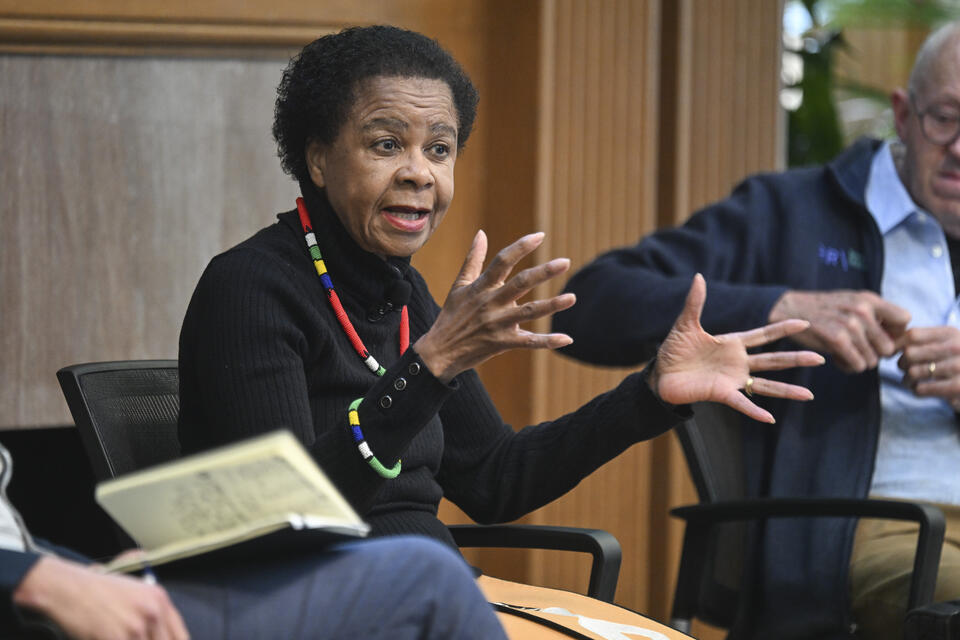
Mamphela Ramphele, PhD, co-founder and advisor for the South African nonprofit organization, ReimagineSA, said the shakeup should push Africans to take the reins.
“I think there is an opportunity being born,” she said. “And for my continent, it’s really an opportunity for the entire continent to stop talking about African unity—and actually make African unity work.”
Ramphele said there are great public health institutions in Africa, such as the African Centers for Disease Control and Prevention, the public health agency of the African Union. And there are myriad opportunities for collaboration at the technical and research level.
But the median age in Africa is 19, she said, while the median age of their leaders is 53.
“You can’t have old men leading a young continent and expect to get different outcomes,” Ramphele said. “And so I believe this shock, this public health tsunami, is also waking up African young people because they too have been sleeping like Americans.”
She challenged the Stanford students in the audience to look outward—to lead not just at home, but to take their passions and skills abroad.
“It’s really important that you do not see yourselves as those who are just going to live here or do some work there, while some old people go off to Washington,” she said. “You must see yourselves as leaders.”
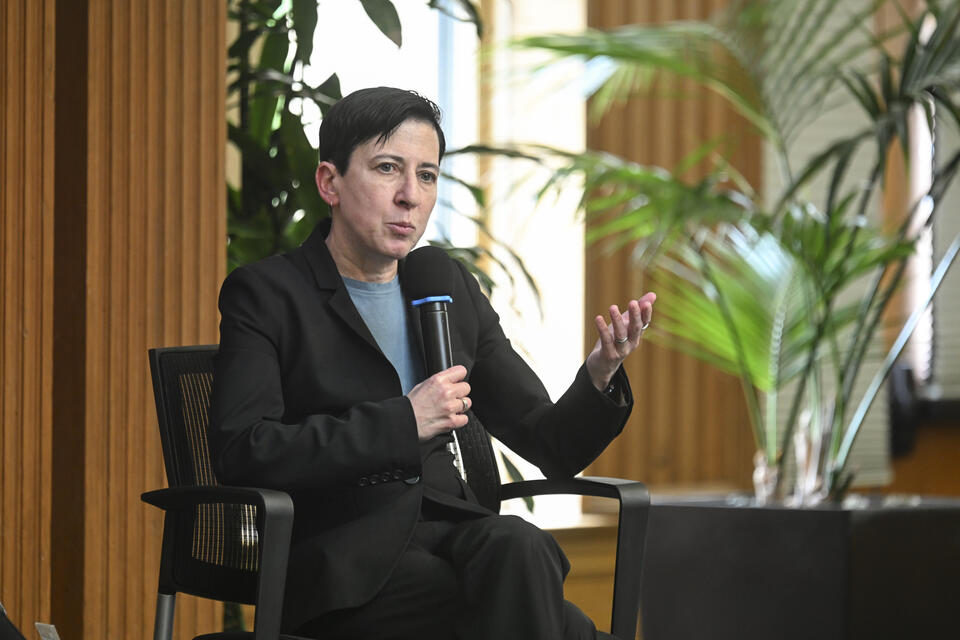
Rice and Kates also urged the Stanford students to remain focused on the public good.
“The challenge for all of you is to not get scared about what's changed but realize that there is an opportunity to build something really different,” Kates said. “We really need you to be thinking, ‘What is the future organization of this work? What should the role of the U.S. be?’ I think there's a real opportunity for the next generation to start to shape this.”
Rice also challenged students to take up public service, noting that the answers to the current upheaval will not come from career diplomats and academics like her.
“I would say that in public service you have the opportunity to be a part of a new president of creation … and the fact that somehow there is still left, I think in the American public in particular, a view that America should not let other people suffer,” Rice said. “So if you want to have a role in taking that value and having it be a part of our foreign policy, part of our global engagement, we need new ideas as to how to do that. And you will come with those new ideas.”


