
Study Investigates Which Specialties Are More at Risk of AI Substitution
Study Investigates Which Specialties Are More at Risk of AI Substitution
As artificial intelligence weaves itself into health care, it will have big implications on the physician workforce. Which specialties are most exposed? Stanford Health Policy’s Maria Polyakova and colleagues analyzed $45 billion in Medicare claims to find out.

Artificial intelligence can already read scans, draft diagnoses and talk with patients, so there is much speculation in the health-care community on whether AI may soon replace physicians.
But software can’t examine bodies, perform surgeries or biopsies, so the amount of hands-on work in a specialty sets a limit on how much AI could take over those fields, at least for the time-being, before robotics technology catches up.
To measure that limit, SHP’s Maria Polyakova, PhD, and colleagues at UC Berkeley and the U.S. Census Bureau sorted nearly $45 billion in 2023 Medicare payments to 590,000 physicians in 56 specialties by whether each service requires physical contact, setting aside office visits.
Their results, published in a NEJM AI Perspective, reveal a sharply variation in exposure to AI substitutability by specialty. Fields such as dermatology and orthopedic surgery are largely shielded from AI takeover as patients are typically treated with hands and instruments, rather than by examination, diagnosis or prescription. And the longer a specialty’s training, the more protected it tends to be.
Only about a fifth of all Medicare payments go to services with no physical barrier to AI. The catch is that most physicians work in primary care fields like family and internal medicine, where hands-on work is a small share of the job, so protection is lowest. The specialties that are easiest to enter and most needed to ease doctor shortages are therefore the most uncertain: AI could replace that work or support it, and which happens will depend as much on how AI is designed, deployed, and paid for as on the technology itself.
“The fields most accessible as career paths and most needed to relieve primary care shortages thus face the greatest uncertainty, because AI could impact their work as either a substitute or a complement—an outcome shaped as much by how AI is designed, deployed, and reimbursed as by the technology itself,” said Polyakova, an associate professor of health policy and the senior author of the paper.
Her co-authors are Dan Zeltzer at the School of Public Health, University of California, Berkeley; Tyler Tam and Benji Bhattacharya, both undergraduate students at Stanford; and Victoria Udalova at the U.S. Census Bureau and SHP’s affiliate.
Who’s At Risk
Polyakova, a health economist who is also a senior fellow at the Stanford Institute for Economic Research (SIEPR) and research associate at the National Bureau of Economic Research (NBER), said that the claims data analysis suggests that outright replacement of physicians by AI is plausible mainly in radiology and pathology because almost all of their work is done by interpretation and not by touch.
Conversely, the researchers found that surgeons and proceduralists are largely safe; and for the primary care doctors who make up the bulk of the workforce, AI’s effect will be decided by policy and design choices, not by the technology alone.
In a chart that sorts 15 big specialties by how much of their tracked Medicare billing is hands-on work, they found that the top hands-on specialties are well protected: Dermatology bills 68% of its revenue for physical procedures; orthopedic surgery 53%; ophthalmology 45%. Only 7 to 13% of their work is the kind that AI could do outright.
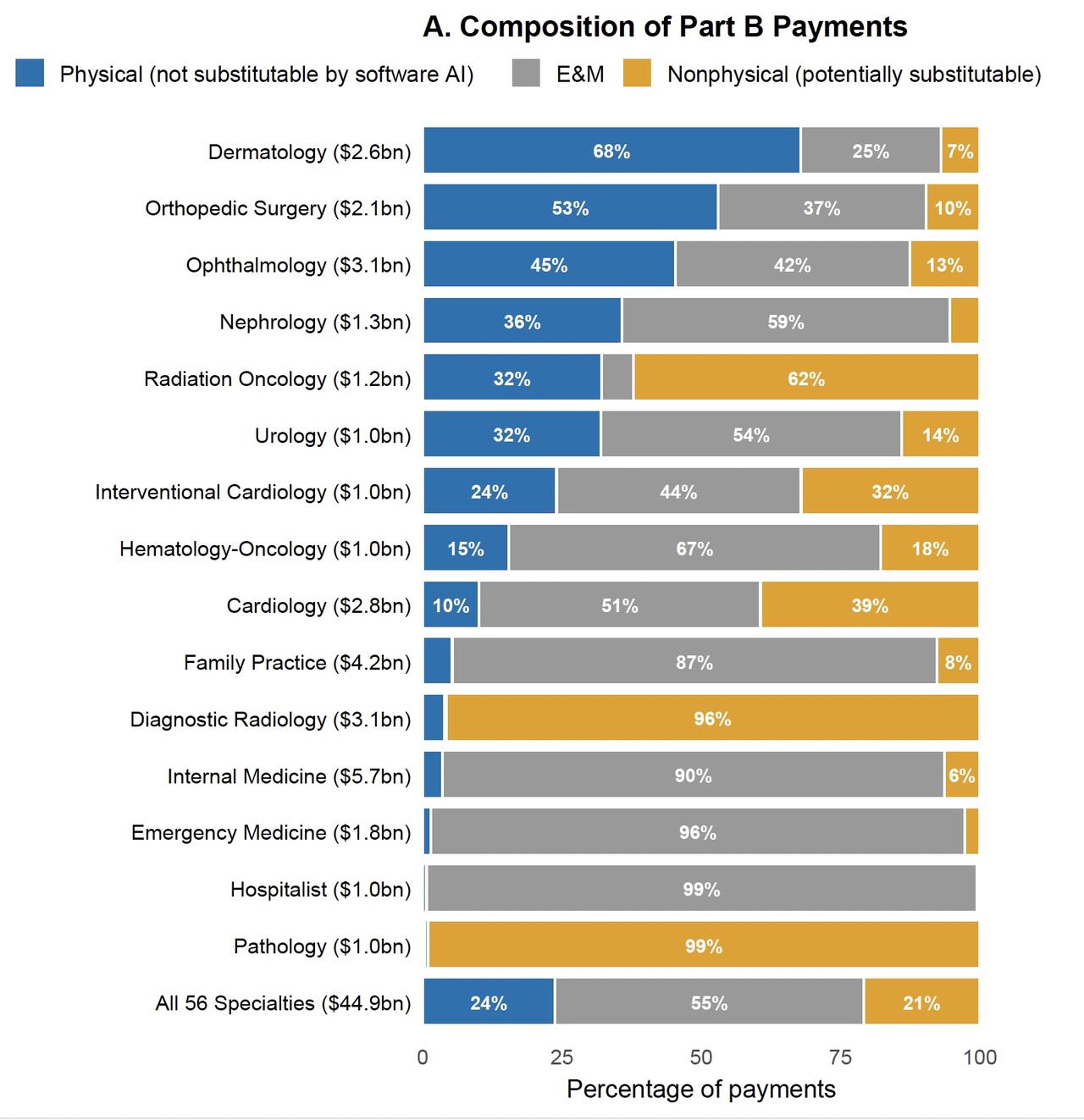
At the bottom, two specialties are almost entirely exposed. Diagnostic radiology at 96% and pathology at 99% in terms of exposure because their work almost entirely consists of interpreting images and slides so have little physical barrier to AI. Those are the fields where “AI will replace doctors” is a real possibility rather than a slogan.
The key takeaway is that across all 56 specialties, 24% of Medicare physician payments go to hands-on work that AI can’t touch, 21% to work AI could potentially do, and 55% to visits where the answer depends on how AI is built, used, and paid for.
“Physical limits to AI implementation are not permanent: Robotic and hardware- integrated systems may, over time, weaken the barrier in procedural fields, and AI may end up augmenting rather than replacing physicians in every specialty,” the researchers wrote in their perspective. “Yet progress in hardware technology moves more slowly than software, so the current differences between specialties are likely to persist for at least several years.”


