
Sara Singer Honored with Top Academy of Management Award
Sara Singer Honored with Top Academy of Management Award
Colleagues joined the Stanford professor of health policy at the annual AOM conference to praise Singer for the wide scope of her research and contributions on how organizations can producer higher quality and safer care.

Stanford Health Policy’s Sara Singer, PhD, MBA, has earned the 2025 Keith G. Provan Distinguished Scholar Award for her pioneering research that is transforming how health care delivers safer, higher-quality care.
The award is the highest honor given by the Academy of Management’s Health Care Management division. Her colleagues joined Singer in Copenhagen, Denmark, to receive the award and praise her academic work.
“Sara is a pathbreaking scholar and defining force in health care management,” wrote her nominating committee, which included other top scholars in the field such as Ingrid Nembhard, PhD, MS, of the University of Pennsylvania. “Her work has made outstanding theoretical and empirical contributions to how and under what conditions organizations can systematically pursue and produce higher quality and safer care.”
In introducing her at the award ceremony, Nembhard noted that Singer—a professor of health policy and of medicine, as well as professor of organization behavior (by courtesy) at the Stanford Graduate School of Business—has built frameworks and tools that advance management theory and make a difference in practice. She described Singer’s body of research as “a treasure trove of conceptual frameworks, measures, practices, and tools for realizing better quality and safety.”
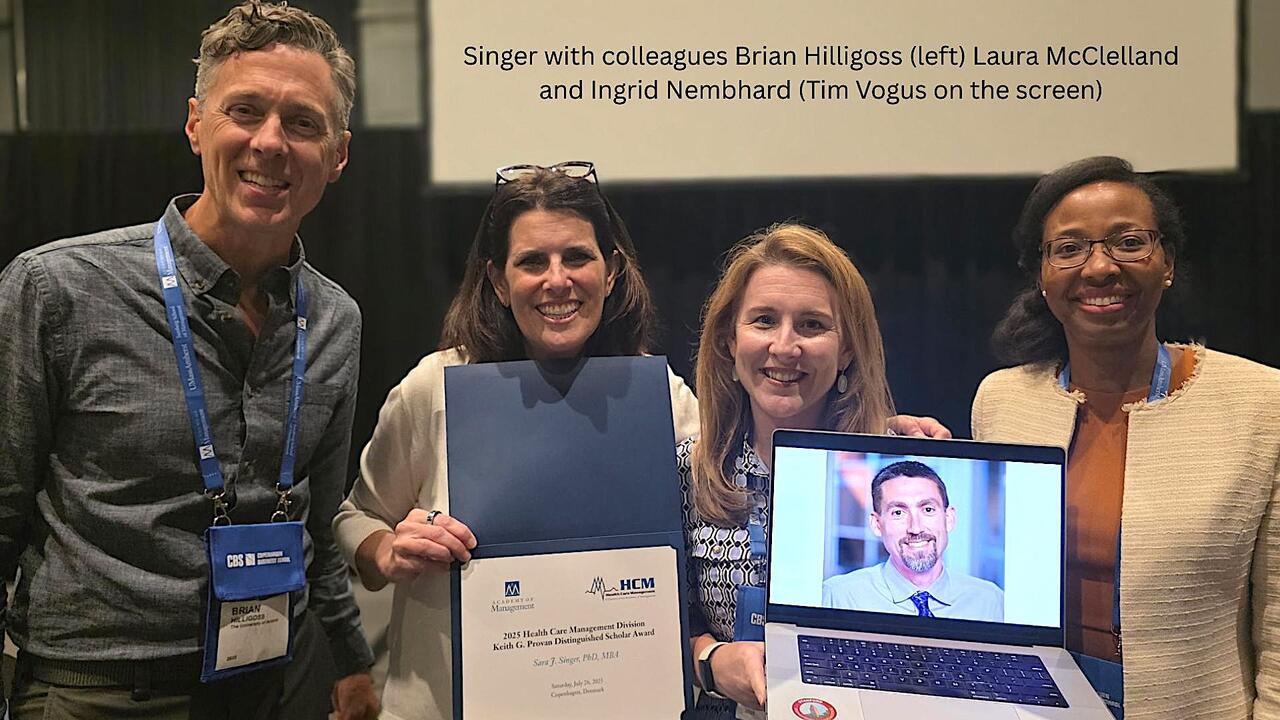
“The scope of her work is extraordinary,” Nembhard said, noting Singer has published more than 300 research papers, including in top journals like Health Affairs, JAMA, and Medical Care Research and Review.
“Her work is wildly impactful with nearly 15,000 Google Scholar citations as well as millions of dollars in federal and foundation funding from every source you can imagine,” Nembhard said. “And this listing is likely inaccurate because during this introduction all those numbers probably increased.”
In their nominating letter, her colleagues praised Singer as a generous collaborator and thoughtful mentor.
“Her biography indicates that she is often the most brilliant, most accomplished person in the room, but her true superpowers are her curiosity, generosity, and deep desire to help,” they said. “The lives and careers of her colleagues and many mentees; the lives of patients, workers and leaders in health care organizations; and the field of health care management are better because of Sara Singer.”
An Uncertain U.S. Health Care Landscape
Having accepted the award, Singer then gave the keynote address at the annual conference. She praised Denmark’s comprehensive health care system, which is largely financed through taxes and free to all residents. While the Scandinavian country spends 10.8% of GDP on health care, the United States spends 17.6%—yet most Americans are unhappy with their health care.
Furthermore, Singer said, the Trump administration’s One Big Beautiful Bill recently signed into law is resulting in even more volatility and uncertainty among health care providers, quoting the Kaiser Family Foundation’s Larry Levitt, who said the bill is “the biggest rollback in federal support for health coverage ever.”
Singer then reminded her audience that health care management experts have played a key role in crises, such as the COVID-19 pandemic. She encouraged the scholars to overcome the uncertainty by focusing on existing research and pointed to her own scholarship to highlight opportunities.
This Too Shall Pass
In closing her keynote in Copenhagen, Singer reflected on some of the lessons she’s learned over the course of her career. She emphasized that, while research must be rigorous, the best research is also relevant. With so many important questions today, she urged her colleagues to focus on problems important to them and to share their findings with those who can act on them.
Singer said choosing problems that allow you to work with great colleagues can also be important for well-being, especially during stressful times.
And she reminded her audience to take comfort in King Solomon’s advice—that history demonstrates that “this too shall pass.”
Nominating Committee
Tim Vogus, PhD, Brownlee O. Currey Jr. Professor at the Owen Graduate School of Management, Vanderbilt University; Stephen Shortell, PhD MPH MBA, Dean and Professor Emeritus at the UC Berkeley School of Public Health; Ingrid Nembhard, PhD MS, Fishman Family President’s Distinguished Professor at the University of Pennsylvania; Laura McClelland, PhD, Associate Professor at the Virginia Commonwealth University College of Health Professions; and Brian Hilligoss, PhD, Associate Professor and Peter and Nancy Salter Fellow at the Eller College of Management, University of Arizona.


